Image



This review contains spoilers.
In January 2024, the infamous directing brother duo, the Safdies, who brought us great films such as Uncut Gems and Good Times, split for good. Each of them pursued their own paths, crafting their own films in the iconic Safdie style that we all came to adore. It’s always sad when something of this nature happens and you can very suddenly realize which half of the duo was the mastermind behind their works.
In this scenario, the brother behind the gut-wrenching, stress-filled anxiety attacks that A24 put to screen was Josh Safdie. Despite Benny Safdie’s good start with The Smashing Machine, he has been utterly overshadowed by his older brother’s masterpiece of marketing, tension-building, subversion, and ambiguity: Marty Supreme.
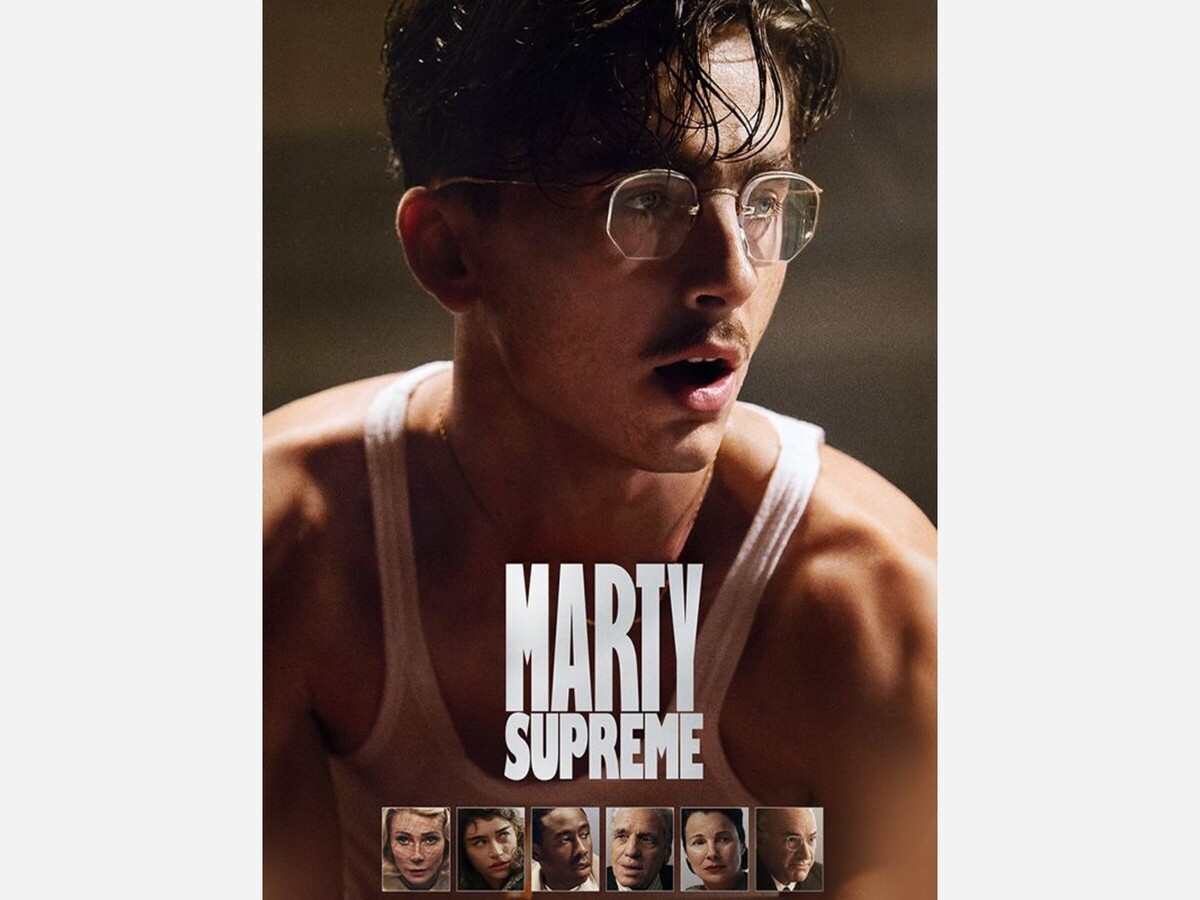
Marty Supreme is the story of Marty Mauser, a young Jewish-American boy growing up in New York City with aspirations to be the face of an obscure sport: Ping-pong. From the very beginning of the movie, after a cold open and title card that rivals Uncut Gems in terms of out-of-pocketness, Mauser’s passion for ping-pong is tangible; he spends hours at his gym practicing his technique before flying to the UK for the British Open. He has a custom ball designed for him because he loves ping-pong. He denies opportunities to be a manager at his uncle's shoe shop because he loves ping-pong. He needs money to get to the UK so he robs his uncle’s shop at gunpoint… because he loves ping-pong.
For a movie that was marketed as an underdog sport’s flick, the movie begins to mutate before our eyes into a very different movie. Around this point, an idea starts forming in the mind of the viewer: Marty isn’t a good person. At the British Open, he makes antisemitic remarks about his friend and opponent who survived a concentration camp. He seduces a married actress because he simply wanted to. He refuses to sleep in the normal building with the other players and instead puts a room at the Ritz on the ITTF, or International Table Tennis Federation, credit card without their knowledge. Most people can agree he is an objectively harmful person for the people in his life. Like so many Safdie films before, Marty Supreme is actually about a man unable to grow, stuck in his narcissistic and immoral ways to his own detriment. We fell for the marketing.
From a technical standpoint, Marty Supreme is a masterpiece. Every moment of screen time has this vibrant yet bleak color grading that I’ve only ever seen before in Birdman or (the Unexpected Virtue of Ignorance). The bright lights and flashiness of New York are juxtaposed with the black hole that is Marty’s poor decision-making. Through the cinematography, this movie does more than I ever would have imagined going in.
However, every other technical aspect of this movie overshadows the directing due to their exceptional nature, specifically the acting. Timothée Chalamet gives one of the greatest performances from an actor in the modern era that I have ever seen. His posture, tone of voice, emotional authenticity, and delivery of lines makes it a stand out performance. So many recent actors and actresses have had incredible responsibilities in films where their performance is make-or-break for the success of the movie. Mikey Madison in Anora, Emma Stone in Poor Things, etc. But I haven’t seen a movie that is so enhanced by a single performance since Christoph Waltz in Inglourious Basterds. Chalamet displays so much charisma and sleaziness and such a palpable desire for greatness that it soaks into your brain as you watch, and you somehow start to root for him. You can somehow cheer on this pathetic hustler in a ping-pong match that doesn’t mean anything against a disabled opponent, and all of that is exacerbated through the subtle yet powerful performance of Chalamet. In a tough year with Michael B. Jordan and Leonardo DiCaprio giving excellent performances, Timothée Chalamet somehow makes himself the only feasible choice for the Oscar this year.
Alongside him is an incredible cast, with Odessa A’zion finding her footing in a Margot Robbie in The Wolf of Wall Street level breakout role, except A’zion does even more with her role than Robbie did. Arguably outperforming Chalamet in certain aspects, A’zion’s subtlety followed by bursts of emotion is an expert skill that she possesses, and she’ll likely see more success in the future thanks to her exceptional performance in Marty Supreme. Tyler Okonma makes a great acting debut, doing exactly what is needed, and Gwyneth Paltrow makes a powerful comeback to cinema in an unforgettable performance. Kevin O’Leary basically plays himself, but he does it surprisingly well. The movie is well edited, with a powerful 80s-inspired score put together by Daniel Lopatin, which deserves an Oscar nod.
Thematically, the movie is too complex to fit into one paragraph. So much is packed into the movie that I can’t even cover the climactic exhibition match against Endo and all the important themes that are tied along with it. Instead, one way that I saw Marty Supreme was a brilliant subversion of the classic underdog story. It asks the same question that so many movies have, such as La La Land or Whiplash: How far will you go to achieve your dreams? Marty is a young Jewish man living in an antisemitic world in the aftermath of the Holocaust. He feels like he has something to prove, a reason to live. He wants to be remembered. His motivation for all the terrible things he does throughout the movie is his desire to be remembered by everybody. When he visits Egypt in the movie, he brings back a piece of the pyramid, remarking, “We built that,” with "we" being Jews. In the wake of the extermination of his people, Marty longs only to have the legacy that so many of his people couldn’t. He sacrifices his family, his friends, and his own life just to have something to be remembered for: ping-pong. He has hopes of being the face of a sport that fills stadiums in the US, being on the cover of a Wheaties box, and having his own branded ball. However, it seems that everything stands in his way. Yet we watch in horror as he stops at nothing to fulfill his dream. How far will you go to achieve your dreams? How long will you as a viewer support Marty’s actions as long as he’s chasing his dreams?
Marty hustles, lies, cheats, and abandons his friends, the mother of his child, and even his career in ping-pong by the end of the movie to just try and leave something behind.
Which leads us to the ending.
Marty Supreme’s ending is ambiguous, as we watch him cry whilst looking in the face of his son. Overall, I came up with three different interpretations of the ending.
Firstly, he is crying because he has no way to hustle out of this scenario. Somehow, he’s squirmed out of every responsibility in his life, but now, through his own decisions, Marty stands on the other side of the glass from a future that he has no way out of. Ping-pong, the stadiums, the Wheaties box—it's all gone. That’s the bad interpretation and not the one that I believe.
Alternatively, you can say it’s a happy redemption story, and that he is crying because he finally realizes that something is more important than ping-pong. However, this movie was made by the same guys who had a guy get killed in the most euphoric moment of his life after winning a gigantic bet (Uncut Gems), so I doubt that Safdie would let Marty get away with that much euphoria.
Rather, I came to my own opinion. The third conclusion is that Marty finally sees what he’s been looking for his whole life: a legacy. A son that will carry on who he was, what he did, and everything he stood for. It’s bittersweet: he got everything he wanted while losing everything he had.
5/5.
A top 40 film of all time for me, it is clearly the best and most polished version of the Safdie style that we have seen from either brother, together or apart, and sets the bar high for their future works.