

Image
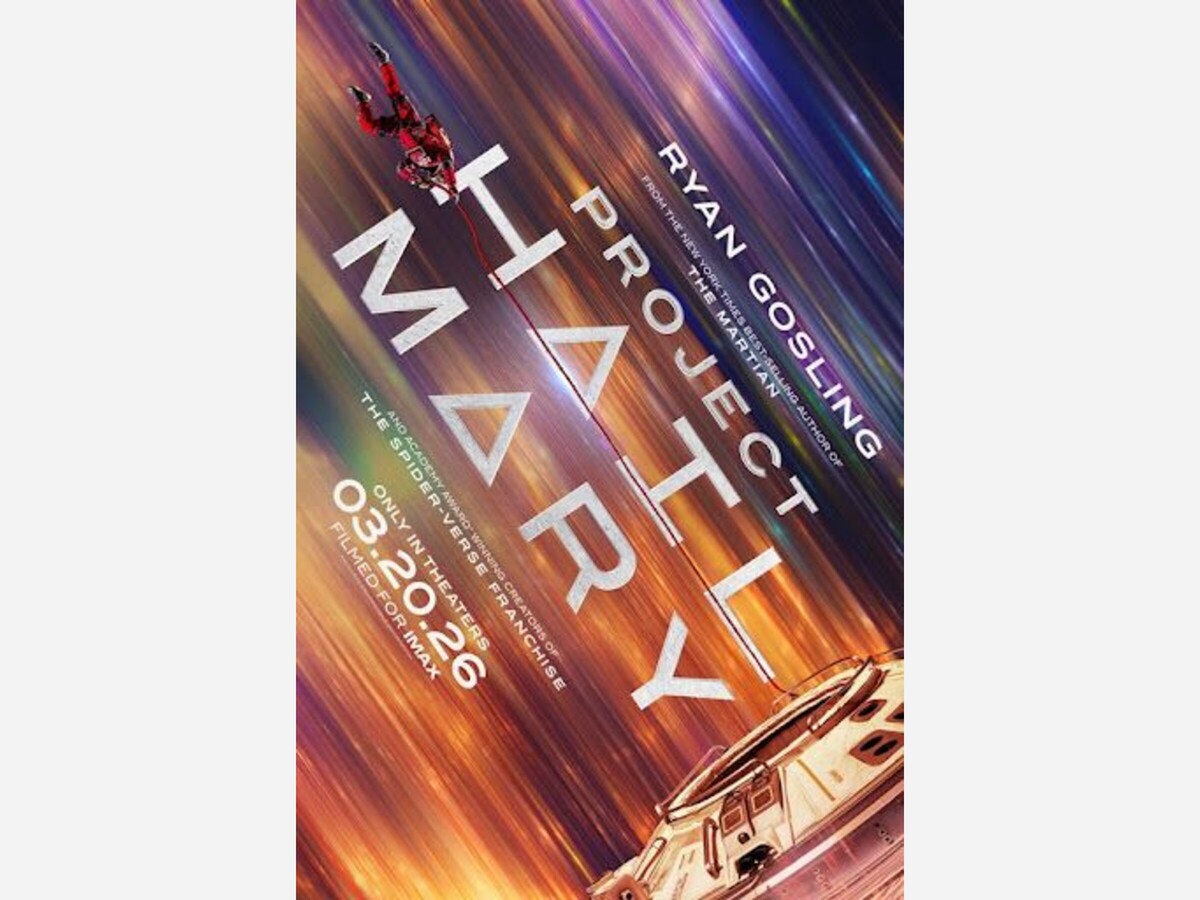
"Project Hail Mary" makes the fifth full feature film directed by the powerhouse duo Christopher Miller and Phil Lord.
While they have been producers for some of the greatest animated films of our era, including the entire Spider-Verse trilogy, The Lego Batman Movie, and The LEGO Movie, their directorial pursuits often lean towards more simple and/or comedic endeavors; Cloudy With A Chance of Meatballs, 21 Jump Street, 22 Jump Street, etc. are all examples of this.
However, with their newest film, the adaptation of Andy Weir’s Project Hail Mary, they prove that they have more nuance and artistic ability than just simple comedies (even though all of those comedies are great nonetheless).
From a technical standpoint, this is arguably the most visually stunning movie of 2026. Despite a crowded year featuring Dune: Part Three, Christopher Nolan’s The Odyssey, and Avengers: Doomsday all slated for 2026 releases, the visual language of Project Hail Mary is so strong that I can comfortably make the statement that it will have the best visuals of the entire year.
Greig Fraser, the most famous cinematographer in Hollywood, adds another masterpiece to his portfolio. As seen in his work in the Dune franchise, the vibrant colors and utilization of light in his cinematography makes him stand out above the rest. Much like his work in The Batman, Fraser emphasizes intimate character moments exceptionally through simple lighting and cinematography in moments shot close up between two characters, and builds upon an already masterfully built world.
Lord and Miller’s direction compliments his cinematography wonderfully. The quick paced shots in action sequences such as the “fishing” scene on Adrian amplify the writing and production. The slower, more methodical shots with large framing display the vacuum of space skillfully.
While some critics have hailed Ryan Gosling’s performance as his career best, I don’t believe it to be anything exceptional. Not that it’s bad, but overall it isn’t the thing that really hooks me in this movie.
His comedic timing is precise, and there are great moments of emotion, but the claim that it’s his best performance ever might be a little misleading. Overall, it’s still one of my favorite Gosling performances, but it isn’t the biggest standout of this picture.
The directing of Lord and Miller, Drew Goddard’s adaptation of Andry Weir’s novel, and Fraser’s brilliant cinematography are all what elevated this film from a good movie to a great one in my opinion.
Thematically, this film serves as a fascinating companion piece to The Martian. While both are Weir adaptations, Hail Mary subverts the most basic structural principle of The Martian: isolation.
In The Martian, the main character is left behind on a mission to Mars and has to survive on his own through resilience and perseverance. Although halfway through the film, he regains contact with humanity and the film pivots into a movie based around the indomitable human spirit and importance of collaboration, Project Hail Mary only explores the lonely principle of space for a short period of time.
The alien character, Rocky, is introduced very early on in the first act of Project Hail Mary, and pivots the entire thematic structure of the film. Instead of focusing on isolation and personal perseverance, Miller, Lord, and Goddard find the fundamental principle that made the book so good: connection.
The connection between Rocky and the main character Ryland Grace serves as the beam of hope needed to make this movie lighthearted. The central plotpoint and conflict of the film is that these microorganisms called “astrophage” are “eating” the Sun. In order to solve this problem, Grace is sent to a solar system with a similar problem very far into deep space, isolated and alone from the rest of humanity, slated to never return.
From that perspective, it’s a very sad movie, but the movie instead introduces Rocky as a way to explore the importance of connection and how that creates hope. There’s hope created between two different creatures that can’t communicate with each other very easily at all. It’s a space movie about hope and connection, just like The Martian, but just in a different cinematic language.
However, I think that the most important aspect of this movie is Grace’s character arc, and how it explores the idea of bravery. Project Hail Mary utilizes non-linear storytelling (another reason this movie is so great), to work backwards in giving us the backstory of how we got to the point we are at in the present.
For example, the movie opens with Ryland Grace waking up in his ship, with all his other crew members dead. He has no idea who he is, how he got there, or why he’s there, and pieces it along throughout the first act. Along the way, we get flashback sequences to his life as a school teacher, and how he was approached by an international taskforce, called the Petrova Taskforce, in order to aid in solving how to kill the astrophage and save the Sun before Earth enters a new ice age.
From these little pieces we’re given about Grace’s backstory, we can make the assumption that he made a sacrifice and chose to be sent out into space with no hopes of return just so he could save humanity. We see Ryland Grace as the pinnacle of bravery and sacrifice, being willing to give up the comfort of his life on Earth for a greater purpose.
Later on in the movie, we get multiple points of emphasis on how brave Grace is. Moments such as the previously mentioned “fishing” scene, or when he enters Rocky’s ship without knowing what could be in there, or just him interacting with Rocky at all without speaking his language or knowing the dangers it could pose.
Then, the film brilliantly pull the rug out from under the audience, as the movie brilliantly strips away all of that bravery in the final flashback sequence which pieces together the backstory of the movie: Revealing that Grace was actually a coward who had to be drugged and forced onto the mission
This immediately starts to take away his credibility and shows that he may truly be a coward, even despite all the bravery shown in the movie. Even Grace believes this, as throughout the whole movie he denies being brave whenever Rocky says he is. This character arc culminates beautifully when, on his way back to Earth, Grace realizes that the new strain of taumoeba started eating the astrophage fuel in his ship after breaking through xenonite. Grace has to make the tough decision between going back to his home or saving Rocky, and in an ultimate act of bravery, Grace chooses to send the taumoeba back to Earth on separate shuttles, and head on a multi-year course to reach Rocky and save him. This final decision by Grace, along with his other actions before creating a beautiful backwards character arc. We start out thinking that Grace is brave, question that conclusion, and then have it confirmed by Grace’s decision. In the end, it didn’t matter that Grace was a coward in the beginning, but instead that he became a sacrificial hero in the end. Due to the nonlinear storytelling, it’s not the typical character arc of a hero where they break at the beginning, but instead is elevated to a more thought-provoking arc that elevates the movie.
Rating: 4.5/5.
Project Hail Mary sits comfortably and confidently as one of the best space films of the decade. Although it’s hard to find any fault with it, I don’t believe it elevates itself to be on par with many of the great emotional space epics such as Interstellar or 2001: A Space Odyssey. However, it’s a close race.