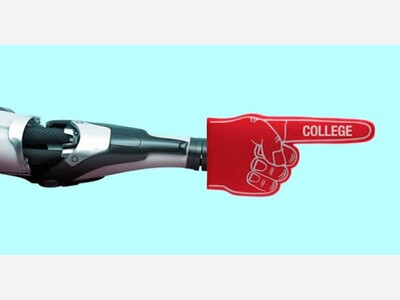


Technology is constantly changing, especially in schools. One of those changes is AI. AI, or “Artificial Intelligence” is a form of computer technology that can complete tasks and answer questions. AI is becoming more popular in schools because it is so accessible.. It is impacting how students learn, including concerns about reliability, overreliance on technology, and changes in human interaction.
It is very normal for students, mainly middle and high schoolers, to Google answers to their homework and search through multiple websites to try and find information. Now, they can simply search for ChatGPT or Google Gemini reviews and easily get the answer they were looking for. However, using AI for homework answers is not always reliable and can often provide incorrect information. One student even states that in Ms.Ellspermann's precalc final that she had ChaptGPT take it and failed. Not only that, but AI answers can also be biased, which can make it difficult for students to tell what information is accurate.
Many teachers worry that students are becoming too dependent on AI. This dependence could negatively affect students’ critical thinking and creativity. Studies have shown that when students use AI to complete projects or homework, they may stop thinking independently, which can negatively affect their learning process in the future. University students who are more reliant on AI lack argumentative skills.
AI is likely here to stay as technology continues to evolve. However, students must learn how to use it responsibly so it does not negatively affect their learning or interaction with others. Students need to learn how much they should use AI and evaluate how reliable its answers are.
Works Cited:
University of Illinois. “AI in Schools: Pros and Cons.” College of Education, College of Education at Illinois, 24 Oct. 2024, education.illinois.edu/about/news-events/news/article/2024/10/24/ai-in-schools--pros-and-cons.
“Does AI Harm Critical Thinking - Duke Learning Innovation & Lifetime Education.” Duke Learning Innovation & Lifetime Education, 13 Aug. 2025, ctl.duke.edu/ai-ethics-learning-toolkit/does-ai-harm-critical-thinking/.
Klimova, Blanka, and Marcel Pikhart. “Exploring the Effects of Artificial Intelligence on Student and Academic Well-Being in Higher Education: A Mini-Review.” Frontiers in Psychology, vol. 16, no. 16, 3 Feb. 2025, pmc.ncbi.nlm.nih.gov/articles/PMC11830699/, https://doi.org/10.3389/fpsyg.2025.1498132.
Healey, Michael. “The Pros and Cons of AI in Education: Benefits, Risks, and Real Examples | Discovery Education Blog.” Discovery Education, 9 Dec. 2025, www.discoveryeducation.com/blog/educational-leadership/ai-in-education/.